FEATURED ARTISTS

FEATURED EXHIBITIONS

Summer's End
Sept 19 - October 12, 2026
The Grenning Gallery is pleased to announce our latest exhibition, Summer’s End; featuring brand new works from Carl Bretzke, Rolf Hellem, and Doug Reina. The exhibition will open on Saturday September 19th, with a reception that evening from 6:00-7:30pm. We invite the public to join us for the opening reception, or to come view the exhibit while it’s on view through October 12th.
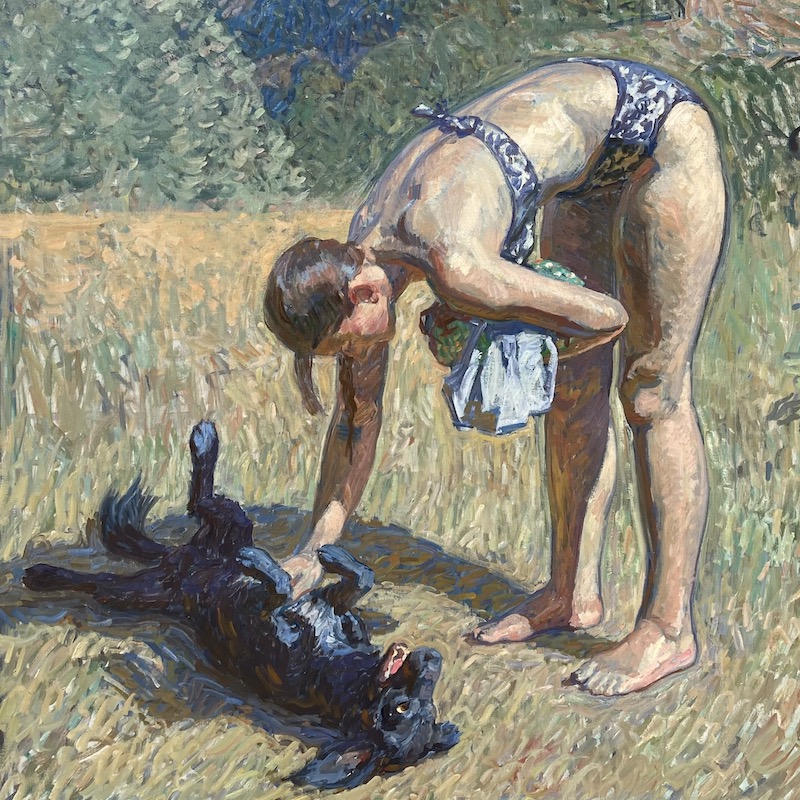
As summer comes to an end, and beachgoers reluctantly return to the bustling city, we have pondered what the presence (or lack) of humans does to our perception of an image. Are we the subjects of the portrait or merely another visual feature akin to wildflowers along the roadway? The three artists spotlighted in this show all take unique approaches to their depictions of humanity. Carl Bretzke uses human figures as artistic punctuation, which hint to a larger narrative but leave room for interpretation from the viewer. Doug Reina, often forgoes the presence of people entirely, instead immortalizing the architecture and objects they leave behind. Finally, Rolf Hellem makes human figures the center of his canvas, with character driven compositions that highlight the individual experience. Together, these painters inspire viewers to think deeply about the role representational artwork plays in shaping our understanding of the living world.
Carl Bretzke (b. 1954, Minnesota)
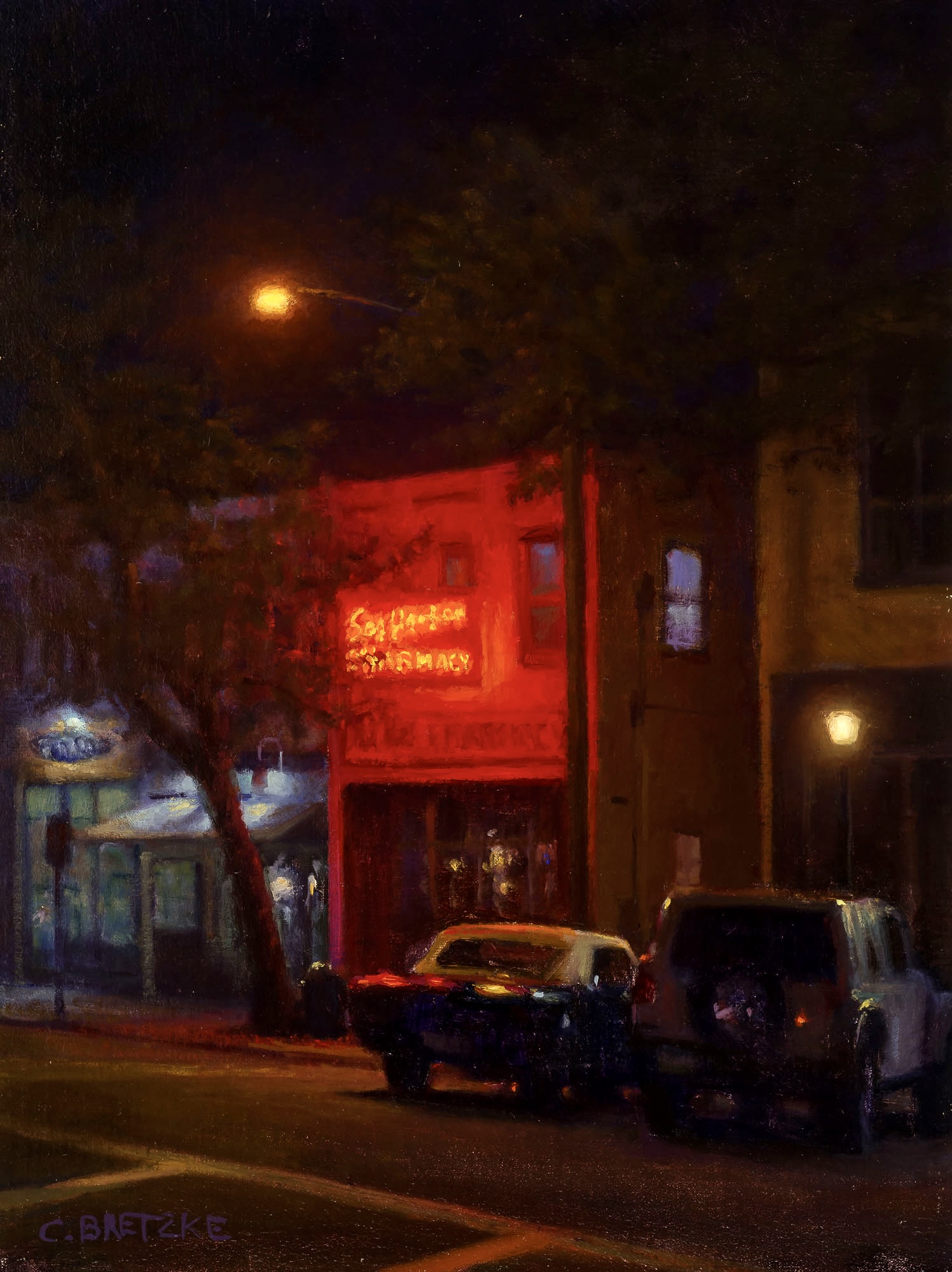
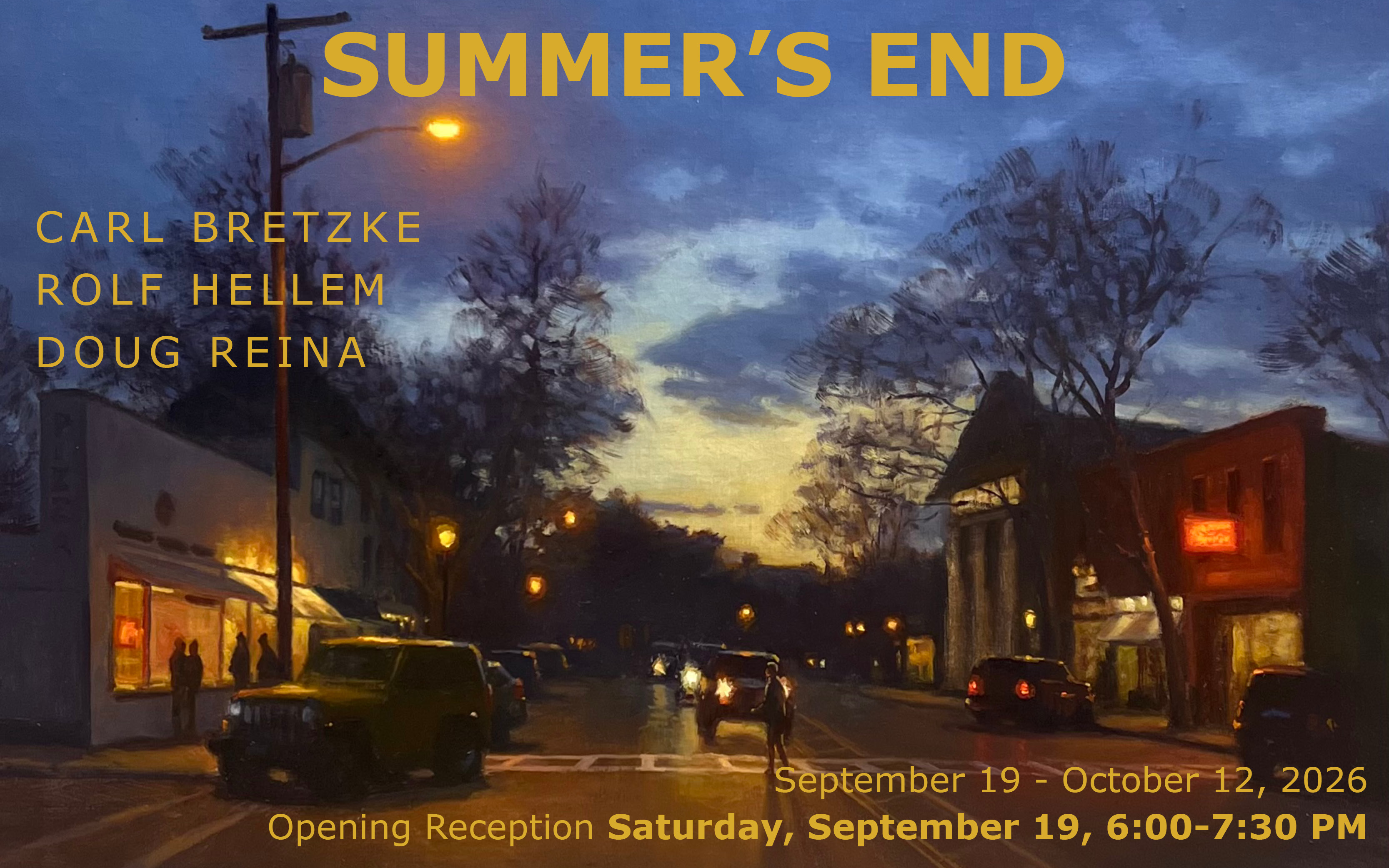
Bretzke’s “Main Street Nocturne” (the banner image for this exhibition) captures a view of Sag Harbor’s Main Street in the early evening, just as the last vestiges of sunlight are fading from the sky. The warm glow of the halogens and streetlights transform a mundane scenario into an otherworldly experience. Human figures appear as backlit shadows, lending anonymous dimension and movement to the canvas. The painting leaves the viewer questioning the exact nature of the moment captured. Is the individual in the middle of the crosswalk merely mid-stride, or are they too frozen in the light of the coming car’s high beams? Is the couple standing in front of Sag Pizza embracing or merely huddling from the wind? Finally, why is the Jeep on the far left illegally parked when there are multiple parking spots clearly available? All these questions contribute to the atmosphere of the painting, evoking feelings of comfort, nostalgia, and intrigue.
In “Waiting for Your Sister” Bretzke’s mastery of composition is on full display. The diagonal swoop of the shoreline encircled by a verdant cove encourages the eye to traverse the canvas in an upward spiraling motion. The colors of the sky are reflected in the mirror finish of the wet sand, the boyish figure in a field of light blue, while the girl is shrouded in the grey shadows of a passing cloud. Here, Bretzke uses human figures as participants in a narrative rather than the focus, the expanse between the two children is ultimately the subject of the painting, one that feels both insurmountable and easily traversed. Bretzke uses the same visual technique in “Last Light Swim”, where the three swimmers are anonymous shadows breaking up the natural beauty of the ocean and sky. The dwindling rays of the setting sun suffuse the cool toned canvas with warm layers of apricot and saffron.
Doug Reina (b. 1959, Long Island)
Where other artists might feel pressure to present an easily digestible narrative within their work, Doug Reina challenges the viewer to unearth their own meaning from his subjects. “Opened for the Season” shows a rear view of single-story green beach house, its white Bahama shutters propped open in anticipation of the summer heat. An exterior door leads down wooden steps into a sea of golden dune grass with no path in sight. To the right of the house, a small patch of white sand is visible with the ocean rising behind. To the left, a light blue A-frame stands on wooden stilts, its windows dark. No footprints, cars, or even pathways mar the landscape of this canvas. The only evidence of human presence are the open shutters and door of the house itself. The exact location of the painting is similarly obscured, the clear blue sky, sand, and seagrass could indicate any number of beachfront properties along the Atlantic coastline. The viewer is left to interpret the scene through the lens of their own experience.
This approach is also extant in “Shack, Left Side View” although here the visible weathering of the channel siding and grey shutters evokes a sense of aging nostalgia. The boarded windows and raised foundation all give the impression of a house standing sentry, awaiting its next season of inhabitants.
Rolf Hellem (b.1998, Norway)
Rolf Hellem’s “Farewell” is a deeply autobiographical painting inspired by the passing of his maternal grandfather. A woman stands atop a cliff, holding the hand of a male child. Another boy crawls over a small outcropping of rocks further back. Far beneath them, a narrow river passes through rocky bluffs leading out towards a Longship facing the sea. Within Norse mythology, these ships signify safe passage into the afterlife. Sunlight splits the clouds in three directions, highlighting the distance between the living and the dead.
“Reflections” has a similarly romantic atmosphere. A blonde woman leans over the edge of a dock, staring into the water below. Her white dress lends the image a sense of timelessness, its style having remained in contemporary fashions for at least half a century. The blue background of the canvas is also left partially unfinished as if referencing the natural haze of human memory.
Lastly, “The Long Row” focuses on a beleaguered fisherman adrift the sea. Full nets of silver fish, highlighted by the dawning sun, reveal this to be the end of a hard day’s work. He holds his oars suspended in the air as he contemplates the remainder of his journey home. Despite the man’s justified exhaustion, he is painfully aware that before he can truly rest, he must complete his long row back to shore.
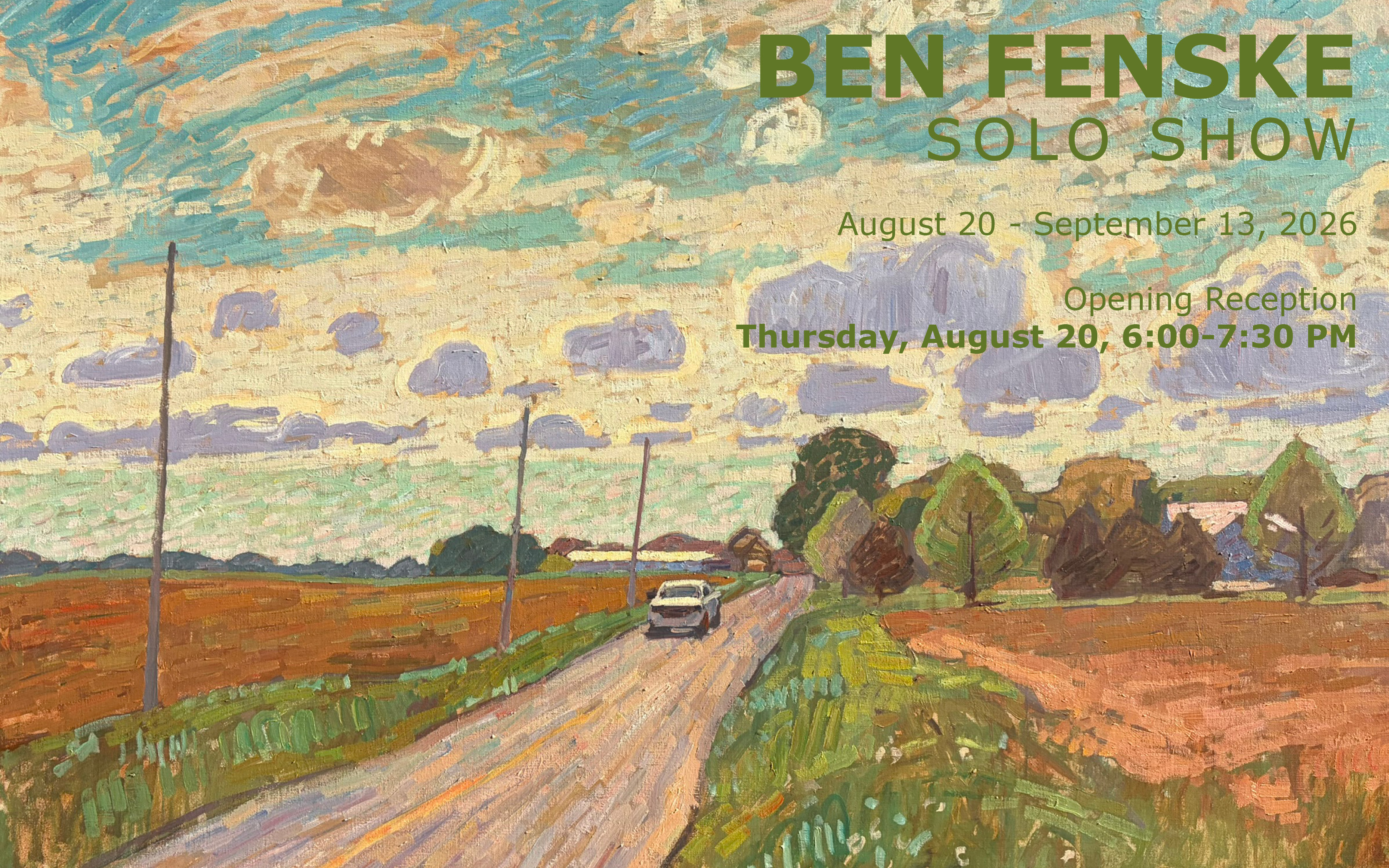
Ben Fenske Solo Show
August 20 - September 13
The Grenning Gallery is pleased to announce our 19th Annual Ben Fenske Solo Exhibition, opening Thursday August 20th, at 26 Main Street, Sag Harbor, NY, 11963. Please join us for the Opening Reception Thursday evening, from 6:00 – 7:30pm; the artist will be in attendance. The exhibition will hang through Sunday September 13th.
“Cooks Lane”, the banner image for this exhibition, showcases the rural landscape of northern Bridgehampton, where fields of farmlands are prepped for sowing and harvest. A single white pickup truck drives along the road towards the viewer, beneath a sky adorned with puffy clouds. A nod towards the humble beauty that attracts so many to our region.
Ben Fenske typically spends several months each year here on the East End, painting our local landscapes on site, en plein air. This year, however, he welcomed his first child, and his new fatherly duties kept him close to home in Tuscany, where he painted this entire new body of work from memory. What resulted is a series of vividly colored paintings built from expressive, divisionist brushstrokes. It is a natural next step for an artist of Fenske’s caliber — after nineteen years spent painting our Sag Harbor landscape from life, he can now paint it from 4,000 miles away.
One of Fenske’s favorite spots to paint Out East is Dering Harbor on Shelter Island. “Dering Herreshoff” shows the moment a sailboat catches a puff of wind. The portrait style dimensions allow for a greater expanse of both the sky and the sea, showing the shifting colors of the water’s surface, especially towards the shallower water in the foreground. A single sailor crosses center frame, heading out to deeper waters as clouds gather overhead. The tall sails reflect onto the water below them, accentuating the verticality of the painting.
“Shelter Island Yacht Club” takes a wider view of the Dering Harbor coastline at early morning. The sea is still, and every boat is resting at its mooring. The clubhouse for the yacht club, a small wood shingled structure with a low white-trim gable, sits unassumingly amongst the horizon line. Short, sweeping brushstrokes vibrate with energy, and appear to burst out from the center of the painting.
“Wave” takes the viewer to the Ocean, where the horizon line forms only where the vast sea meets the sky above. Fenske preserves a moment, as the cresting waves crash onto umber sand. Fenske’s distinct painting style layers staccato brush strokes in various colors to capture the ever-shifting colors in natural light. His skies and seas are never just blue, they capture a spectrum of hues including, green, lavender, pink, and yellow.
One of the largest paintings in the show, “Montauk” takes a panoramic view of a crowded harbor. Various fishing boats are docked around the small peninsula of land while a large flock of seagulls gather overhead.
“Newborn” is a beautiful reflection of Ben Fenske’s recent fatherhood. It shows his long-time partner, Amy, carrying their newborn son across the Tuscan landscape they reside upon. The mostly bare deciduous tree reveals the subject was painted several months prior, in late winter or early spring. Still, the bright colors highlighted throughout the canvas transform a partially barren landscape into a celebration of new beginnings. Perhaps a reflection of the painter’s own joy over his growing family.
Together, these paintings trace a season unlike any other in Fenske's career — familiar shores rendered from thousands of miles away, filtered through memory and the first months of fatherhood. The result is some of the most vivid, emotionally charged work of his nineteen years at Grenning Gallery.
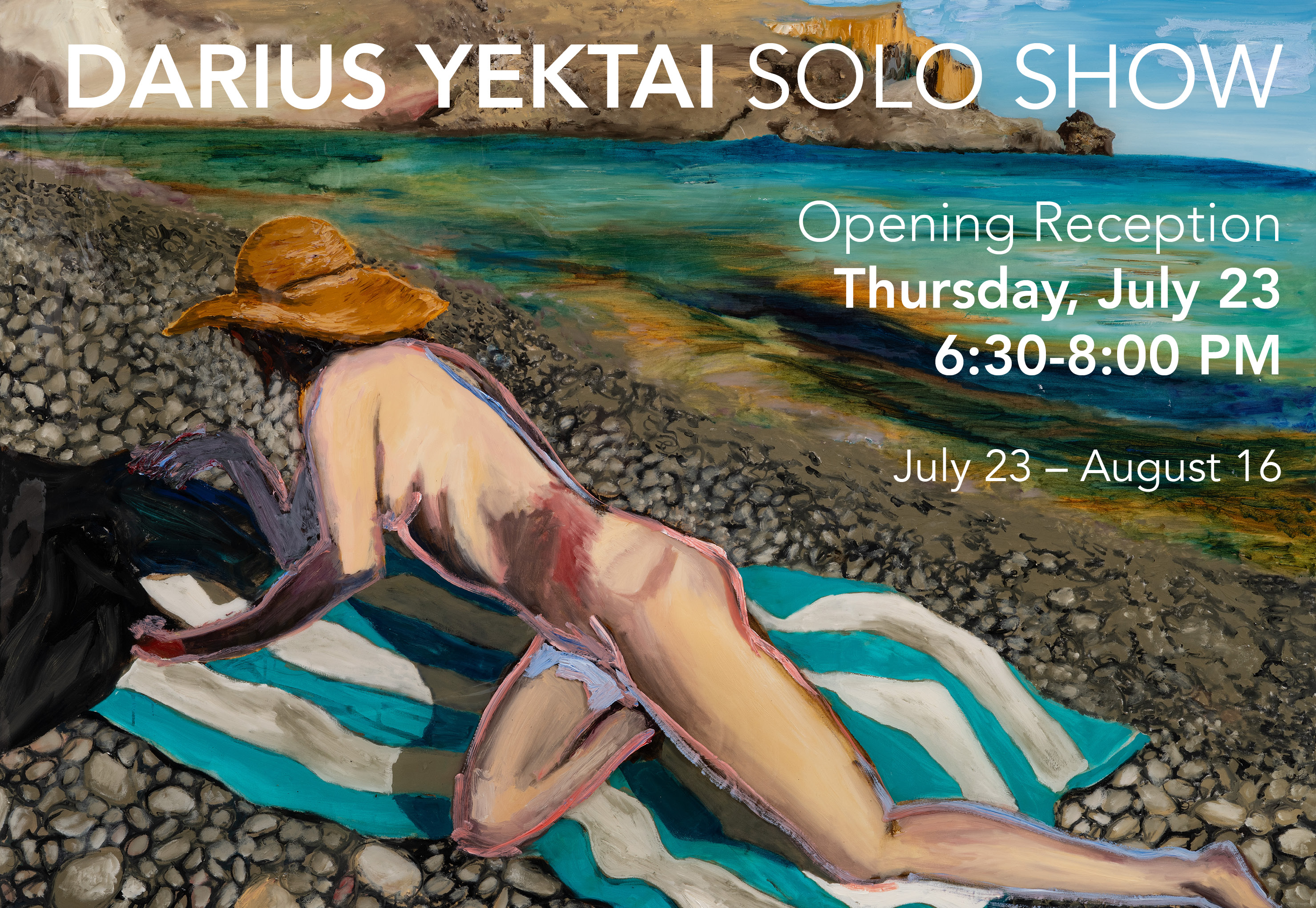
Darius Yektai Solo Show
July 23 - August 16, 2026
The Grenning Gallery is pleased to announce our Darius Yektai Solo Exhibition, opening Thursday July 23, at 26 Main Street, Sag Harbor, NY, 11963. Please join us at our Opening Reception Thursday evening, from 6:30 – 8:00pm; the artist will be in attendance. The exhibition will hang through Sunday August 16th.
Now in its seventh consecutive year, the annual show has become a summer fixture at Grenning Gallery — a milestone that finds Yektai returning to beloved territory while pushing into new ground. Longtime collectors will be pleased to find his signature 3-dimensional waterlily paintings and abstract flower compositions that have become synonymous with his name at Grenning Gallery, alongside the debut of a colorful new figurative series and several abstract paintings. These new works expand Yektai’s oeuvre beyond the florals and waterscapes, for which he is best known. Where Kasos 8 lingers on texture and color up-close, Kasos 5 pulls back to a wider, almost surrealist view of the island. The figure stands partially submerged, back to the viewer, gazing toward the horizon. Heavy impasto in the rocky bluffs plays against the mirrored finish of the sea, where a deep blue sky drips down in pigment.
Yektai’s range of color, vivid or restrained, comes through in a trio of new, large scale falling flower paintings: Rising Rose, Falling Lily Tree, and Dark Charcoal Lilies — that share the same branching floral motif carried across three distinct palettes. Rising Rose burns in gold, orange, and red, with high-contrasting stems and clusters of red blossoms ascending above a ground that appears to radiate heat. Falling Lily Tree shifts into deep plum and magenta, its white blossoms and green vining stems threading through the composition like the last light of dusk on an overcast day. Dark Charcoal Lilies strips the palette down entirely, pairing ghostly fusain line work in the upper register with a dense, inky mass of black foliage below — shadow standing in for color. Seen together, the three paintings function almost as a study in mood: the same botanical language, refracted through fire, air, and light.
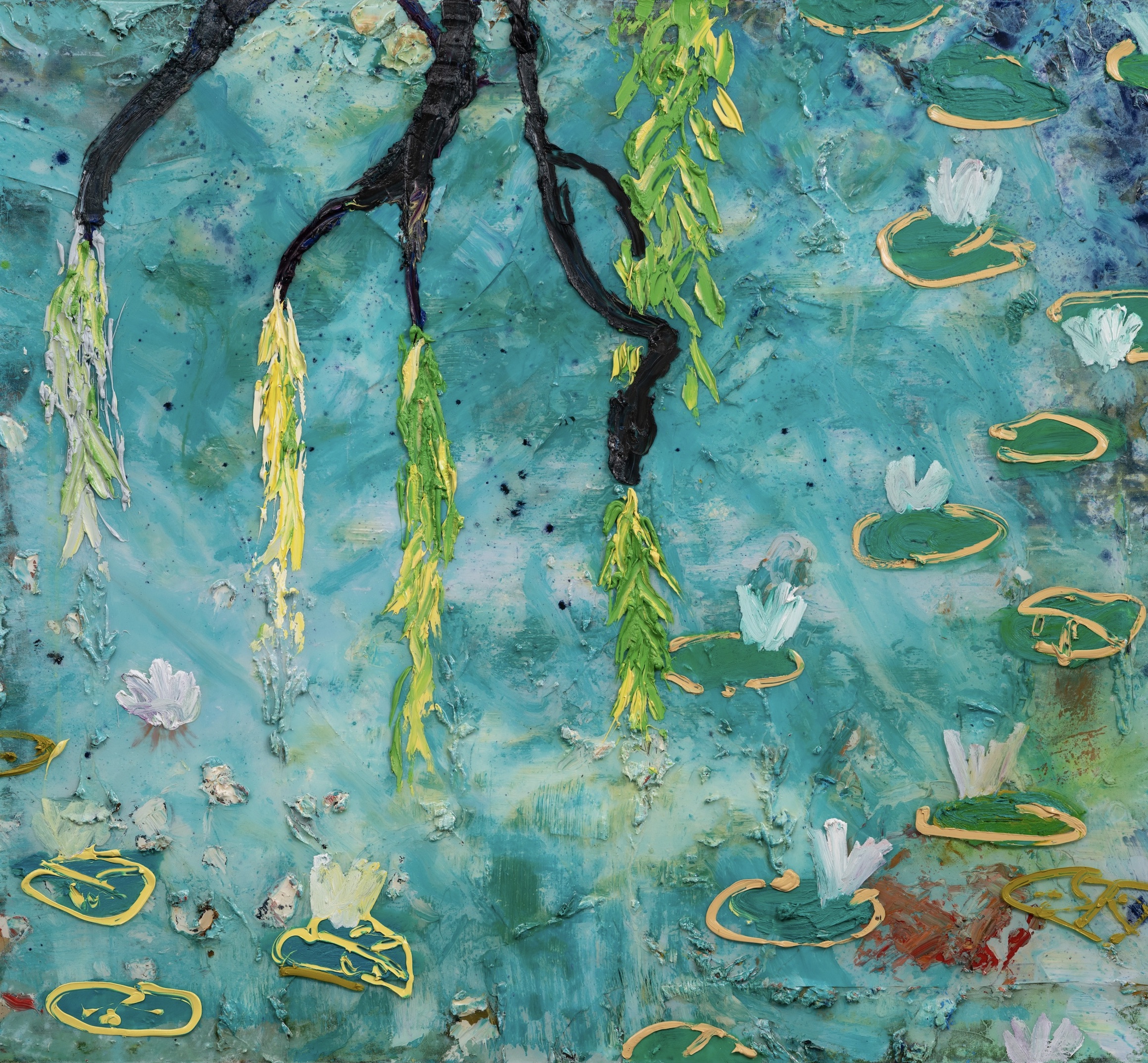
The show also introduces several new entries in Yektai's popular waterlily series, including Manganese Cerulean Pond. The painting's cool, silvery hues echo its namesake mineral, while a single weeping willow branch extending from the upper left corner — its foliage bright white and yellow — anchors an otherwise somber, contemplative landscape, offering a quiet visual respite from the noise of daily life. Across the broader waterlily series, Yektai continues to explore varied hues — from subtle neutrals to electric chartreuse — alongside an assortment of sizes, shapes, and an eclectic mixture of frames.
Like Yektai’s waterlily paintings, his closely observed local landscapes benefit from his intimate and concentrated attention. Edge of Long Pond exhibits Yektai’s impression of the Long Pond Greenbelt, just steps from his studio. Branches reach across the canvas atop that landscape, forcing the viewer to closely observe the scene’s native flora. Long Pond through the Trees is all about the titular subject, the trees. Up close, we see thickly painted branches standing upright, catching light and casting shadows. A green underpainting presents a watering hole just below the horizon, relaying a glimpse of the landscape in which these trees inhabit. And finally, in Duck Blind, our eye naturally gravitates to the eastern redbud which stretches across the canvas, yet the painting takes its name from what lies hidden beneath. A verdant pondscape encircling a duck blind, a small hut camouflaged by natural reeds and grasses, to allow hunters to take aim on their prey, hidden in plain sight. Yektai’s ability to look deeply at the local landscape and create gorgeous abstractions continues to amaze us.
In Corner of Table by Field, Yektai continues to blur the line between still life and landscape. One of the more traditional compositions in the exhibition centers a colorful tabletop holding two flower vases, situated within a field beneath a blooming tree. A post-and-rail fence stretches across the canvas, emphasizing the unadorned charm of this rural landscape. As always, his thick layering of paint and resin invites the eye to linger, tracing each emerging layer of the composition. Rendered in natural colors yet accentuated with lush jewel-toned brushstrokes, the pastoral scene recalls the sensuous French landscapes of Pierre Bonnard.
As does, View of Porter and Roses – a colorful mountain scene rendered in loose pointillistic brushstrokes. Sweeps of grey and blue pigments make up the sky above a contrasting forest green mountain peak, which encompasses ragged valleys and bluffs of soft pale greens and earthy oranges. At the mountain’s base, is a life-size vase of flowers; facing the viewer head-on with romance – dried roses preserved in resin mimic the pointillist brushwork throughout.
That romance continues in Moonrise over Chamonix; a large vertically oriented painting which amplifies and exaggerates the light of a full moon over the French Alps. Beams of light reach from the lustrous orb at the mountain’s peak, in every direction. A meadow is illuminated at the base of the mountain range, where a field of wildflowers shimmer in red, pink and yellow forms. A backlit figure stands before the glorious scene with a dog, taking in the moonlit beauty. This composition reminds us how tiny one can feel amongst the grandeur of our environment.
Yektai’s abstraction Earth Touching 1 is a raw canvas washed in a splattering of neutral pigments showcases spheres of both solid color and negative space. A red sphere floats above a green sphere, which sits upon a ground of blue and airy white. Yektai implements a pattern of pink and orange hash-like brushstrokes that outline the upper edge of the composition. Although other than shapes, there are no representational forms, the composition offers the viewer a chance to observe and anticipate what may be happening. The viewer may sense a similar experience as the figure did in Moonrise over Chamonix, where one’s own form debates the scale and tangibility of forms before us, and how they may exist beyond our perceptible comprehension.
RECENT PRESS
Inside Art by Streamline Publishing | June 2026
What the Light Does When No One is Watching
Written by Kelly Kane. Carl Bretzke spent 30 years as a surgeon before he became a full-time painter — and the transition, it turns out, was less dramatic than it sounds. Both disciplines, he will tell you, are fundamentally about seeing. “In medicine, you see what you know,” he says. “In painting, you paint what you see. You must know it, to see it, to paint it.”

SouthForker Magazine | Nov-Dec 2025
At the Very Heart of It
Making the case for buying, and collecting art, even on a budget. Written by Emily Toy. "The act of buying art, and the reasons why to do it, are largely an emotional endeavor. The first and most important reason to buy art is simple, and somewhat obvious: You buy it because you love it."

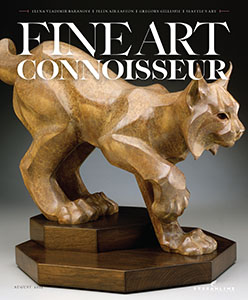
Fine Art Connoisseur - July/August 2025
LOOK UP: DEPICTING THE SUN & MOON By Max Gillies
"All too often, we take them for granted. Every now and then, though, we slow down to refocus on the sheer wonder of our sun and our moon. Without the former, we simply could not exist and it is the moon that governs our tides and (usually) illuminates our nights..."